

How wild is it to think that computers could enter a new world where bits dance between 0s and 1s—sometimes both at once? Well, that’s exactly what quantum computing promises. Imagine a computer that doesn't just calculate but explores possibilities, unlocking puzzles we never thought solvable. In this post, we'll unravel the basics of quantum computing. I'll explain how qubits, with their quirky traits, are set to change everything from finance to healthcare. Trust me, this tiny marvel could redefine our digital landscape. Ready to explore this exciting frontier? Let's dive in.
Understanding Quantum Computing Basics
Quantum computing is like a new way of doing computer magic. Instead of using regular bits that are either a 0 or a 1, quantum computing uses qubits. These qubits are the tiny, powerful units of information that can be in more than one state at a time. This means they can be 0, 1, or both at the same time. It sounds a bit like science fiction, right? But it's real, and it lets quantum computers tackle problems traditional computers find impossible or take forever to solve.
Now, let's talk about superposition and entanglement. Superposition is the mind-bending ability of qubits to exist in a blend of states. Imagine you're spinning a coin. While it's spinning, it could land on heads or tails, but it's sort of both until you catch it. That's superposition for qubits. Entanglement is even cooler. When qubits become entangled, they're like two dancers perfectly in sync. If you change one qubit, the other will change in a predictable way, even if they're far apart. This interconnectedness boosts quantum computing power.
-
Processing Power: Quantum computers can process vast amounts of data simultaneously, while classical computers do it one step at a time.
-
Data Storage: Qubits store more information than classical bits, thanks to superposition.
-
Problem Solving: Quantum computers solve complex problems faster, such as breaking encryption, which classical ones can't do easily.
-
Parallelism: Quantum computers explore many solutions at once, unlike classical computers, which follow one path at a time.
-
Error Rates: Quantum computers have higher error rates compared to classical computers, needing error correction techniques.
The Role of Qubits in Quantum Computing

Qubits are the fundamental building blocks of quantum computing. Unlike classical bits, which are strictly a 0 or a 1, qubits can exist in multiple states simultaneously thanks to a principle known as superposition. Have you ever wondered how this works? Well, in a sense, qubits can be thought of like a spinning coin that is simultaneously both heads and tails. This unique property allows quantum computers to process vast amounts of data at once, a feat far beyond the capabilities of classical computers. The magic doesn't stop there, though. Qubits are also capable of entanglement, meaning the state of one qubit can depend on the state of another, regardless of the distance between them. This kind of connection is what gives quantum computers their extraordinary power.
How exactly do qubits boost computing power? Imagine solving a maze. A classical computer would try every path one by one, while a quantum computer, with its qubits in superposition, can explore many paths simultaneously. This means quantum computers can tackle complex problems, like breaking encryption or simulating molecules, much faster than classical machines. The potential applications are vast and transformative. With qubits, the future of computing looks incredibly promising, paving the way for breakthroughs across various fields, from material science to finance.
|Characteristic |Qubit |Classical Bit|
|—————-|—————————–|————-|
|States |Multiple (superposition) |Single (0 or 1)|
|Data Processing |Simultaneous (many solutions)|Sequential (one at a time)|
|Interconnection |Entangled (dependent states) |Independent |
Real-World Applications of Quantum Computing
Quantum computing is opening new doors across several industries. But where does it really shine? Well, its potential is vast. From transforming how we optimize complex systems to revolutionizing machine learning, quantum computing is making a mark. It's particularly promising in areas like financial modeling, healthcare, and material sciences. Let's take a closer look.
In finance, quantum computing holds the key to better financial modeling and risk analysis. How can it help with financial modeling? By crunching through vast data sets much faster than classical computers. This enables more accurate predictions and insights. Risk analysis benefits too, as quantum computers can simulate countless scenarios in seconds. Imagine being able to predict market shifts with greater precision. That's a game-changer for financial institutions.
Healthcare is another field ripe for quantum transformation. Quantum computing could lead to breakthroughs in drug discovery. How so? By simulating molecular interactions at a much faster pace. This means researchers can identify potential new drugs quicker, speeding up the process of bringing life-saving medications to market. It's like having a super-powered microscope to explore the tiniest details of how drugs work in the body.
Material science is also set to benefit from quantum simulations. These simulations can revolutionize how we understand chemical reactions and materials. What's the impact here? It could lead to the development of more efficient processes, such as improving fertilizer production. This means we might produce fertilizers that are cheaper and environmentally friendly, helping to feed the world more sustainably. Quantum computing's potential in these real-world applications is truly transformative.
Key Developments and Breakthroughs in Quantum Computing
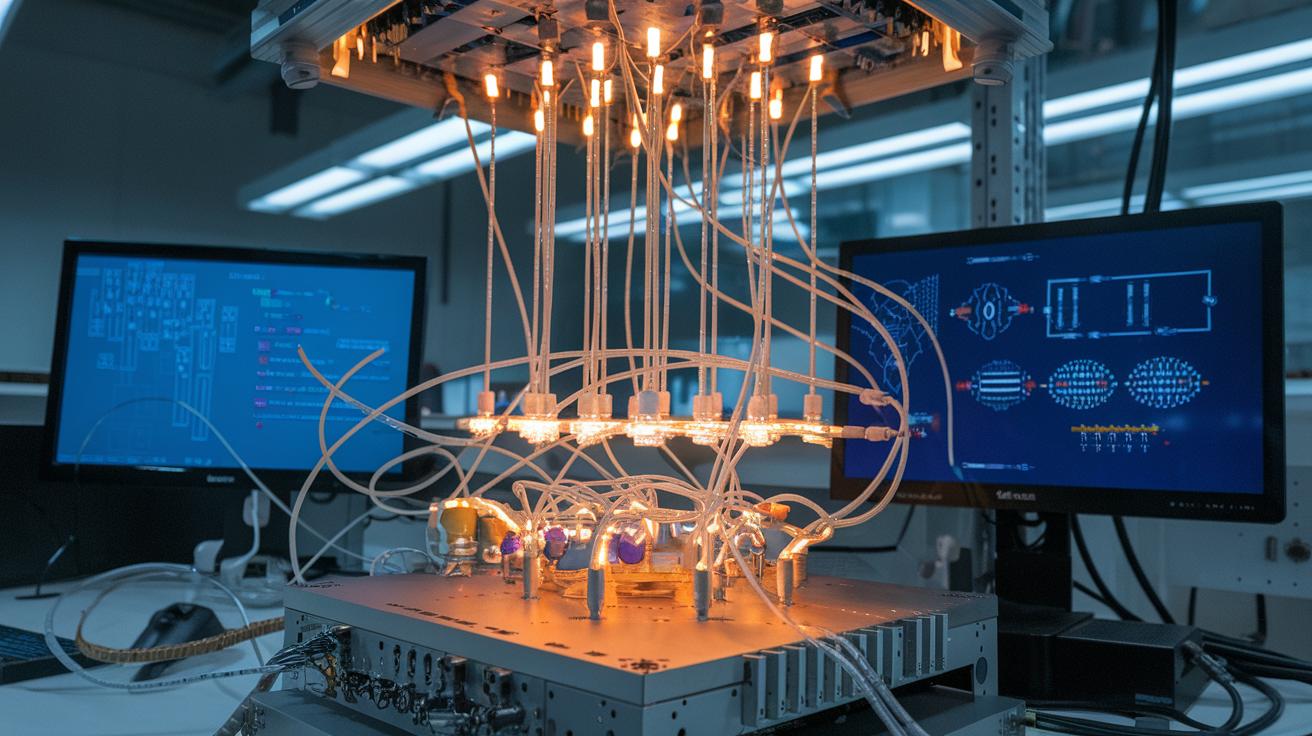
Quantum computing has been on a fascinating journey since its early days in the 1980s. Back then, it was mostly theoretical, with scientists exploring the possibilities of using quantum mechanics for computing. A major leap came in 1994 when Peter Shor developed an algorithm that could factor large numbers exponentially faster than classical algorithms. This was a game-changer because it showed that quantum computers could potentially break widely-used encryption systems. Fast forward to 2001, IBM made headlines by successfully demonstrating Shor's algorithm on a small quantum computer, proving that these theoretical ideas could be turned into practical technology. This laid the groundwork for the rapid advancements we're seeing today.
In recent years, there have been significant breakthroughs in quantum computing technology. One of the most talked-about developments is Microsoft's Majorana 1 chip. This chip is built from a new kind of material that boosts its performance, especially in high-level computing tasks. What makes it special? It can execute complex operations more quickly and accurately than previous quantum systems. IBM has also continued its pioneering work by using Shor's algorithm on larger quantum systems, showcasing the potential of quantum computing to solve problems beyond the reach of classical computers. These advancements hint at a future where quantum computers could tackle complex challenges in various industries, from cryptography to material science.
- IBM: Known for its early work with Shor's algorithm and continuous innovation in quantum technology.
- Google: Made waves with its claim of achieving "quantum supremacy," where a quantum computer solved a problem faster than a classical one.
- Microsoft: Developed the Majorana 1 chip, pushing the boundaries of quantum performance.
- Rigetti Computing: Focuses on building scalable quantum systems and has made significant strides in hybrid quantum-classical computing models.
Challenges and the Future of Quantum Computing
Quantum computing is like trying to balance on a tightrope made of spaghetti—it's tricky. One of the biggest challenges is decoherence, which is when qubits lose their quantum state due to interference. Think of it as trying to hold onto a soap bubble while surrounded by cacti. Noise is another hurdle, introducing errors that can mess up calculations. Quantum error correction comes into play here. It's like having a team of tiny mechanics constantly fine-tuning the system to keep everything running smoothly. But making these corrections requires lots of extra qubits, adding to the complexity.
Now, how are researchers tackling these issues? Well, they’re hard at work developing new materials and techniques to reduce noise and extend coherence time (how long a qubit can maintain its state). Scientists are also exploring error correction codes, which are like smart filters that catch mistakes before they cause problems. It's a bit like adding shock absorbers to a delicate race car. All these efforts aim to make quantum computers more stable and reliable.
Looking ahead, the future of quantum computing is bright and full of promise. Imagine computers that can solve problems we haven't even dreamed of yet. With advancements in scalable quantum computing, we could see breakthroughs in everything from drug discovery to climate modeling. This technology could potentially revolutionize industries by providing solutions to complex challenges faster than ever before. The possibilities are endless, and we're just getting started on this exciting journey.
Final Words
Quantum computing, with its fascinating principles like superposition and entanglement, offers a glimpse into an exciting future. This powerful technology might change how industries like finance and healthcare tackle complex problems.
Qubits, the building blocks of quantum computing, offer capabilities far beyond classical bits, allowing us to explore vast data in ways we couldn't before.
Yet, challenges like noise and scalability remain. But researchers' continuous efforts promise groundbreaking solutions.
Though it has hurdles to clear, quantum computing holds the potential to revolutionize our world in remarkable ways. Here's to what lies ahead!
FAQ
What is quantum computing in simple terms?
Quantum computing relies on qubits, which can be in multiple states at once due to superposition. This makes them faster at solving complex problems compared to classical computers, which use bits.
What is a real life example of quantum computing?
Real-life examples include drug discovery in healthcare, optimizing complex financial models, and improving cybersecurity by breaking traditional encryption codes.
Why did NASA shut down the quantum computer?
NASA's quantum computer shut down for maintenance and upgrades, requiring updates to ensure optimal performance for its computing needs.
Has a quantum computer been built?
Yes, quantum computers have been built and are operational, with companies like IBM and Google actively advancing quantum technology.
What is the difference between quantum computing and AI?
Quantum computing processes complex calculations faster with qubits, while AI involves algorithms and data analysis to mimic human-like decision-making. Quantum computers can greatly enhance AI capabilities.
How do qubits differ from classical bits?
Qubits can exist in a state of 0, 1, or both simultaneously, unlike classical bits which are strictly 0 or 1. This allows faster processing of vast data.
Are there courses available to learn quantum computing?
Yes, there are various courses on quantum computing, offered by universities and online platforms, covering concepts like qubits, superposition, and entanglement.
How does Microsoft approach quantum computing?
Microsoft focuses on topological quantum computing using unique particles called anyons, which potentially offer more stable qubits, enhancing quantum computer reliability.
What are key challenges in the future of quantum computing?
Key challenges include managing noise, overcoming decoherence (loss of quantum state), and implementing quantum error correction to build more reliable and scalable systems.
What industries could be transformed by quantum computing?
Industries like finance, healthcare, and material science could be transformed by quantum computing through enhanced data analysis, new drug discoveries, and revolutionary material designs.
